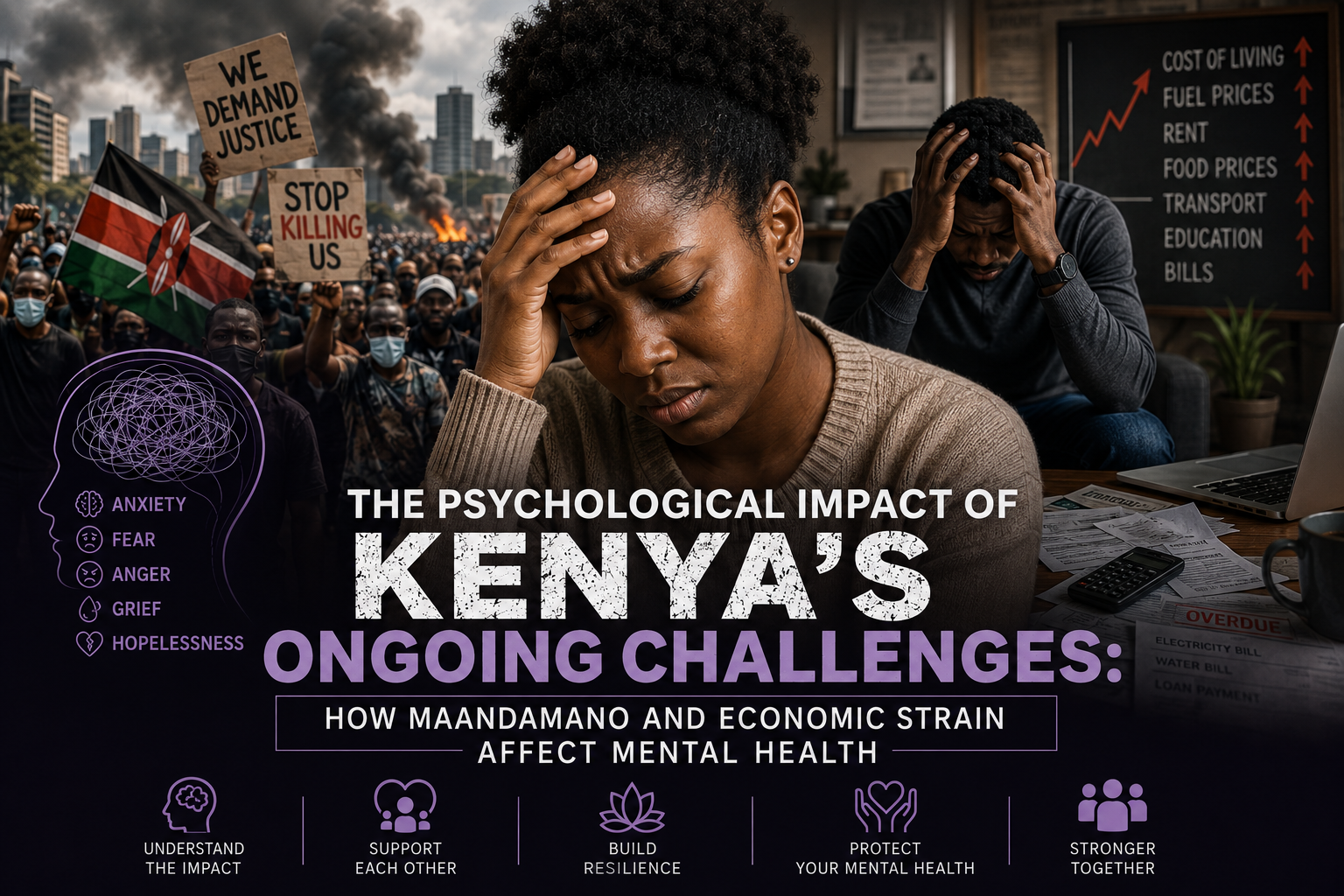

Between rising prices, job worries, and the tension around maandamano, many people are quietly struggling.
Maybe you've noticed yourself feeling more anxious, more tired, or quicker to snap at family.
Maybe scrolling through news or social media leaves you unsettled long after you've put your phone down.
These reactions are normal. When uncertainty becomes constant, it takes a real toll on how we think, feel, and function at home, work, and in our communities.
This article looks at how Kenya's ongoing challenges are affecting mental health, and more importantly, what we can do to protect our wellbeing through it all.
Economic Uncertainty and Financial Stress

For many Kenyans, worry about money has become a daily companion.
The cost of unga, fare, and rent keeps climbing, jobs feel less secure, and small businesses are closing their doors.
This becomes both a financial and a psychological problem.
When the body stays on high alert about survival, week after week, it doesn't get a chance to reset.
This kind of chronic financial pressure is one of the most consistent triggers of anxiety and depression that mental health professionals see.
It wears people down slowly: sleep suffers first, then concentration, then mood.
And because money stress often can't be solved quickly, it tends to show up in everyday life rather than as a single dramatic event.
Common signs of financial-strain stress include:
- Trouble falling or staying asleep
- Irritability or feeling on edge over small things
- Difficulty concentrating at work or school
- Fatigue that doesn't improve with rest
- A sense of dread about the future
The Psychological Effects of Repeated Exposure to Maandamano and Distressing News
You don't have to be on the street to feel the weight of a protest.
Watching tear gas clips, reading updates on casualties, or scrolling through alarming headlines can leave a mark, even from the safety of your living room.
Journalists who covered the 2024 protests describe this vividly. Standard Newspaper reporter Fred Kagonye said the coverage affected him so deeply that he reached a point where he became numb.
A young protester named Serah described living with ongoing fear long after the demonstrations, saying the intimidation convinced her she'd been wrong to protest at all, and that she isn't sure she'll do it again.
Multiple research studies point out that people repeatedly exposed to violence may become more fearful and vigilant than usual, with disrupted sleep and stress symptoms consistent with PTSD.
This kind of exhaustion, sometimes called secondary trauma or compassion fatigue, is real, even for bystanders.
If you've felt jumpy, tearful, or strangely detached from the news lately, you're not overreacting. If it's becoming hard to manage alone, a professional space to process it can help you make sense of what you're feeling.
When National Stress Turns Into Anger, Fear, Grief, and Hopelessness
These reactions are your mind's honest response to prolonged instability.
The trouble starts when these feelings don't pass, but instead settle in and start running the show. The following table shows the progression from normal to emotions going overboard.
| Emotion | Normal, healthy expression | Warning sign it's becoming harmful |
| Anger | Speaking up, advocating, setting boundaries | Constant irritability, outbursts, straining relationships |
| Fear | Caution, staying informed | Avoiding daily life, panic, constant dread |
| Grief | Mourning losses, honoring victims | Numbness, isolation, prolonged despair |
| Hopelessness | Temporary discouragement | Persistent low mood, withdrawal, substance use |
The goal isn't to stop feeling but to notice when a feeling has outstayed its purpose and start gently working through it, ideally with support around you rather than alone.

When individuals are stretched thin, it ripples outward.
Parents under financial and emotional pressure may find themselves shorter-tempered with their children.
Couples under strain may argue more over things that wouldn't normally matter.
At work, stressed employees show up but can't fully focus while others start missing days altogether.
The human cost of this moment is deeply personal. A Kawangware cobbler, Magdalene Naliaka, described watching her son shot during the 2024 protests, and losing her shoe-repair stall in the chaos that followed, leaving her unable to support her remaining children.
Stories like hers are extreme, but they capture something true for many families: national strain doesn't stay "out there." It comes home. Some of the ripple effects show up as:
- Increased conflict or shorter tempers within families
- Children picking up on adult anxiety, even without being told what's wrong
- Reduced trust between neighbours or community groups
- Lower productivity and higher absenteeism at work
- Young people feeling disillusioned about the future
Protecting Mental Wellbeing During Times of National Uncertainty
- Limit news and social media intake. Check updates at set times instead of scrolling constantly.
- Protect your routines. Regular sleep, meals, and movement anchor your nervous system when everything else feels unstable.
- Stay connected. Isolation makes stress heavier; even short check-ins with people you trust matter.
- Name what you're feeling. Putting words to an emotion takes away some of its power.
- Get professional support when you need it. You don't have to wait until things fall apart to ask for help.
For anyone looking for structured support, whether personal counseling or training a team to better handle stress and mental wellbeing, WellSawa Mind Solutions offers exactly that kind of professional space.
Kenya has weathered hard seasons before, and people have found their footing again. The path forward starts small; one boundary, one honest conversation, one good night's sleep at a time.
You don't have to carry all of this alone, and you don't have to have it all figured out. Call us today and let’s talk.