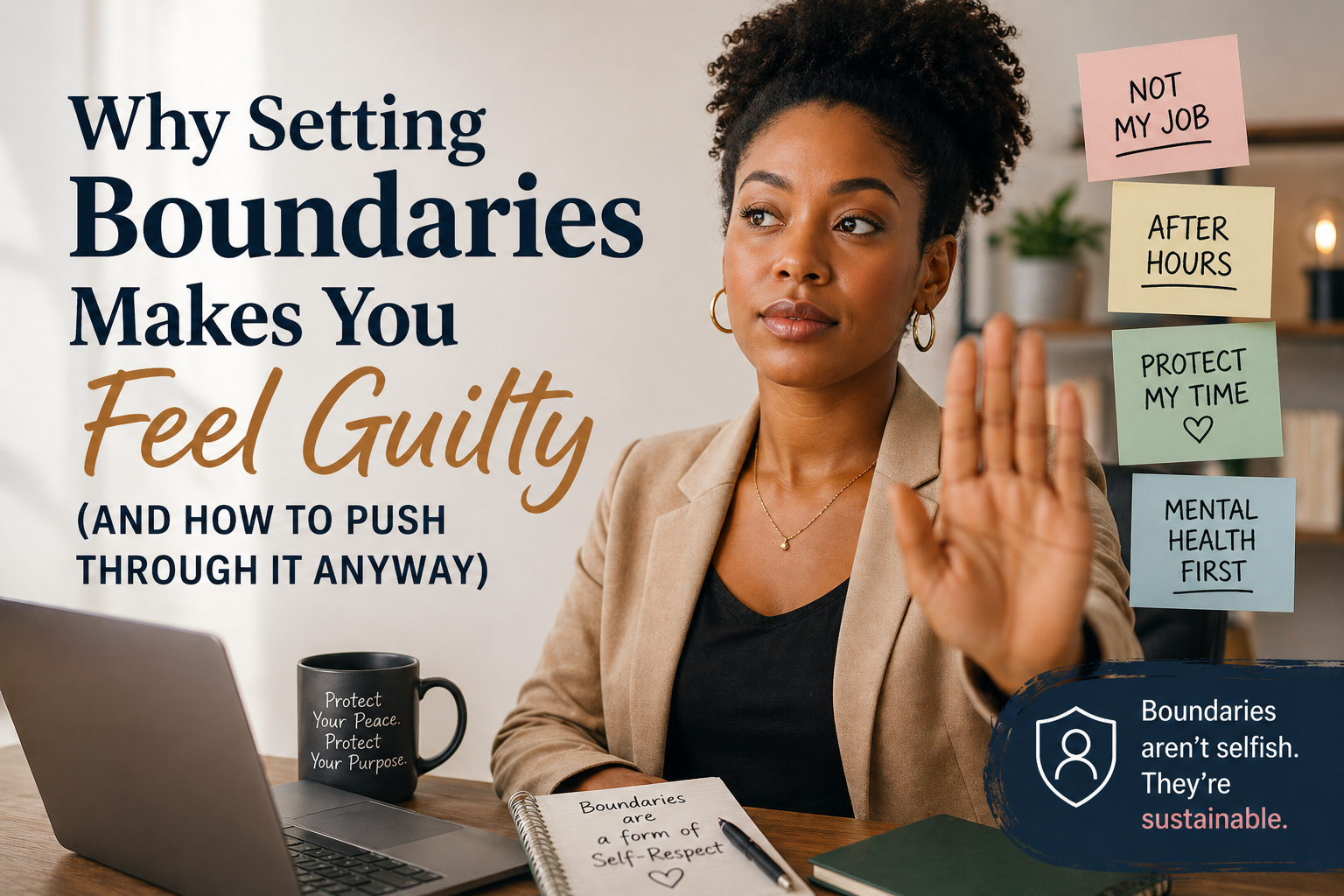

You tell your manager you can't take on one more project.
And then the guilt kicks in. Not a small twinge. A full wave of why do I feel guilty setting boundaries at work — even though you know, rationally, that you had every right to do what you did.
Sound familiar? That guilt isn't a sign you did something wrong. It's a sign you did something new.
Boundaries feel uncomfortable because they challenge years of conditioning, messages about what it means to be a "good" employee, a team player, a reliable person.
This article breaks down exactly why that guilt shows up and what you can do to push through it without abandoning the limits you've worked hard to set.
1 - You've Been Taught That Your Worth Comes From Being Available
Think about how you learned to be "good" at your job.
Chances are, a big part of it involved being responsive. Replying quickly. Saying yes. Showing up when people needed you.
Over time, that pattern becomes part of your identity. Your availability starts to feel like your value.
So when you set a boundary, it doesn't feel inconvenient. It feels like you're diminishing yourself. Like you're suddenly:
- Less capable
- Less committed
- Less worthy
This is one of the core reasons the psychology behind guilt when saying no at work is so persistent.
It's not a surface-level reaction; it's rooted in a deep, often unconscious equation: availability = worth.
Until you start questioning that equation, boundaries will keep feeling like a personal failing rather than a professional skill. These beliefs often show up as:
- Feeling like you must always respond immediately
- Equating saying no with being unhelpful
- Believing rest or limits mean you’re slacking

Your brain doesn't distinguish well between actual danger and perceived danger.
And for a social species like ours, the risk of disapproval can feel just as threatening as a physical threat.
When you say no to a colleague or push back on a deadline, your nervous system can read that as a potential rupture in your social connection.
Your brain fires off a warning, such as
- They might not like you anymore
- You might be seen as difficult
- You could be left out
Guilt is the emotional response to that alarm.
It's your brain's way of nudging you back toward "safe" behavior, which, in this case, means being agreeable, accommodating, and easy to work with.
Understanding the psychology behind guilt when saying no at work means recognizing that this response is wired in, not a reflection of reality.
The reframe: Notice the alarm, but don't obey it automatically. Ask yourself, did anything bad actually happen after the last time you said no? In most cases, the answer is no. Your brain's prediction was wrong. It usually is.
3 - You Confuse Discomfort With Doing Something Wrong
One of the most common traps people fall into when they start setting limits is that they feel uncomfortable, and they interpret that discomfort as a moral signal.
This feels bad, so I must have done something bad. But why setting boundaries feels wrong even when it's healthy is simpler than it seems, because it's unfamiliar.
You're doing something you haven't done before, or haven't done often enough.
The discomfort isn't evidence of wrongdoing. It's the feeling of doing something new. That discomfort often shows up as:
- Replaying the conversation in your head
- Feeling the urge to take back what you said
- Worrying you came across as rude
- Second-guessing whether the boundary was necessary
But over time, those things got easier. Not because they stopped mattering, but because they became familiar.
The reframe: Discomfort is not a red light. It's a yellow light. It means proceed with awareness, not turn back immediately. You can feel uncomfortable and still be doing the right thing.
4 - You're Breaking an Unspoken Agreement With Others
In most workplaces, informal roles get established over time, often without anyone explicitly naming them. You become:
- The person who stays late
- The one who picks up the extra work
- The one who makes things smooth for everyone else
And even when those expectations were never fair, stepping away from them can feel like a betrayal.
This is a key part of understanding boundary guilt in the workplace mental health conversations: guilt often arises from implied contracts, not real ones.
The following table contrasts the transition that occurs when you start making changes.
| Before Boundaries | After Boundaries |
| You always say yes | You start saying no when needed |
| You carry extra workload | Work is redistributed or delayed |
| Others rely heavily on you | Others adjust expectations |
| You feel stretched but accepted | You feel relief mixed with guilt |

There's a destructive narrative in many work cultures that truly strong, dedicated employees simply handle it.
They don't complain.
They don't push back.
They don't need limits, because their commitment is supposed to be unlimited.
You may have absorbed this message without even realizing it. When you start setting limits, that internalized standard gets activated.
Suddenly, you're not saying no to a task but failing the test of the ideal employee.
The guilt is your inner critic comparing your actual behavior against an impossible benchmark. This belief is often reinforced by:
- Praise for overworking
- Comparing yourself to colleagues who never say no
- Pressure to always prove your commitment
- Fear of being seen as replaceable
Boundarylessness isn't a sign of strength. It's a path to depletion.
The reframe: Setting a boundary isn't opting out of doing good work. It's opting into doing your best work — consistently, over the long haul, without running yourself empty.
How to Push Through the Guilt Anyway
Understanding why the guilt shows up is the first step. But it doesn't make the feeling disappear; it makes it less powerful. The following are actions you can take to push through the guilt:
Name it out loud (or on paper). Naming the feeling creates a small but meaningful gap between you and the emotion. You're observing it rather than being driven by it.
Check the facts. Did anything actually bad happen? Did someone lose their job? Did the team fall apart? In most cases, the answer is no. Your brain predicted disaster and in reality nothing major happened.
Practice tolerating the discomfort. Don't try to make the guilt go away by undoing the boundary. Sit with it. It will pass. And each time it passes, it gets a little shorter and a little quieter.
Connect the boundary to your values. Ask yourself: what does this boundary protect? Your health? Your focus? Your time with family? When you link the limit to something meaningful, it becomes easier to hold.
Get support. If boundary guilt is persistent and intense, if it's stopping you from advocating for yourself in ways that really matter, it may be worth working through with an experienced therapist.
Ready to Set Boundaries Without Guilt?
Boundary guilt at work doesn’t mean you’re wrong, it reflects conditioning, fear of disapproval, and discomfort with change.
At MeHWK, we offer workplace mental health training and therapy to help you and your team build healthy boundaries and thrive.
Book a session or training today and start working with clarity, not guilt.